


Standard containers are also known as general purpose
containers. They are closed containers, i.e they are closed on all sides.
These can fit most of your common needs. Standard containers are designed
and constructed for transportation of general cargo on sea, rail, and land.
They are also able to withstand extreme temperatures ranging from -40°C
(-40°F) to 70°C(-158°F) without affecting their strength and
water-tightness. Standard containers are used for all types general cargo(dry cargo).High cube containers are used for all types general cargo(dry cargo).
However, they are particularly suitable for transporting light, voluminious
cargoes and overheight cargoes up to a maximum of 2.70 m tall.
Standard containers are mainly used as 20' and 40' containers. Containers
with smaller dimensions are very seldom used. Indeed the trend is towards
even longer dimensions, e.g 45'.
Europe has its own domestic pallet wide containers that are slightly different dimensionally than the standard ISO boxes. Typically they are wider (usually 2.5 meters) to accomodate European pallets (in the case of dry vans). Pallet wide containers' characteristics are equal to standard containers' ones, except dimensions. Although pallet wide containers are typically not used in worldwide service.

Hard Top Container has two typical distinguishing
structural features. On the other hand, it is equipped with a removable
steel roof. In some types, this roof has points for accommodating forklift
truck. The roof weighs approx. 450 kg. In addition the door header may be
swivelled out. These two structural features greatly simplify the process
of packing and unpacking the container. In particular it is very easy
to pack and unpack the container from above or through the doors by
crane or crab when the roof is open and the door header is swivelled out.
In the case of transport of an overheight cargo, the container roof may
be left open and fastened directly to a side wall on the inside of the
container. To do this, the roof only needs approx. 13cm(51/8") of space.
Usual hard-top container dimension are 20' and 40'.
Hard type containers are used for all types of general cargo.(dry cargo).Their
principle uses are as follows:
-Heavy Cargo
-Tall Cargo
-Loading from above or through the doors by crane or crab

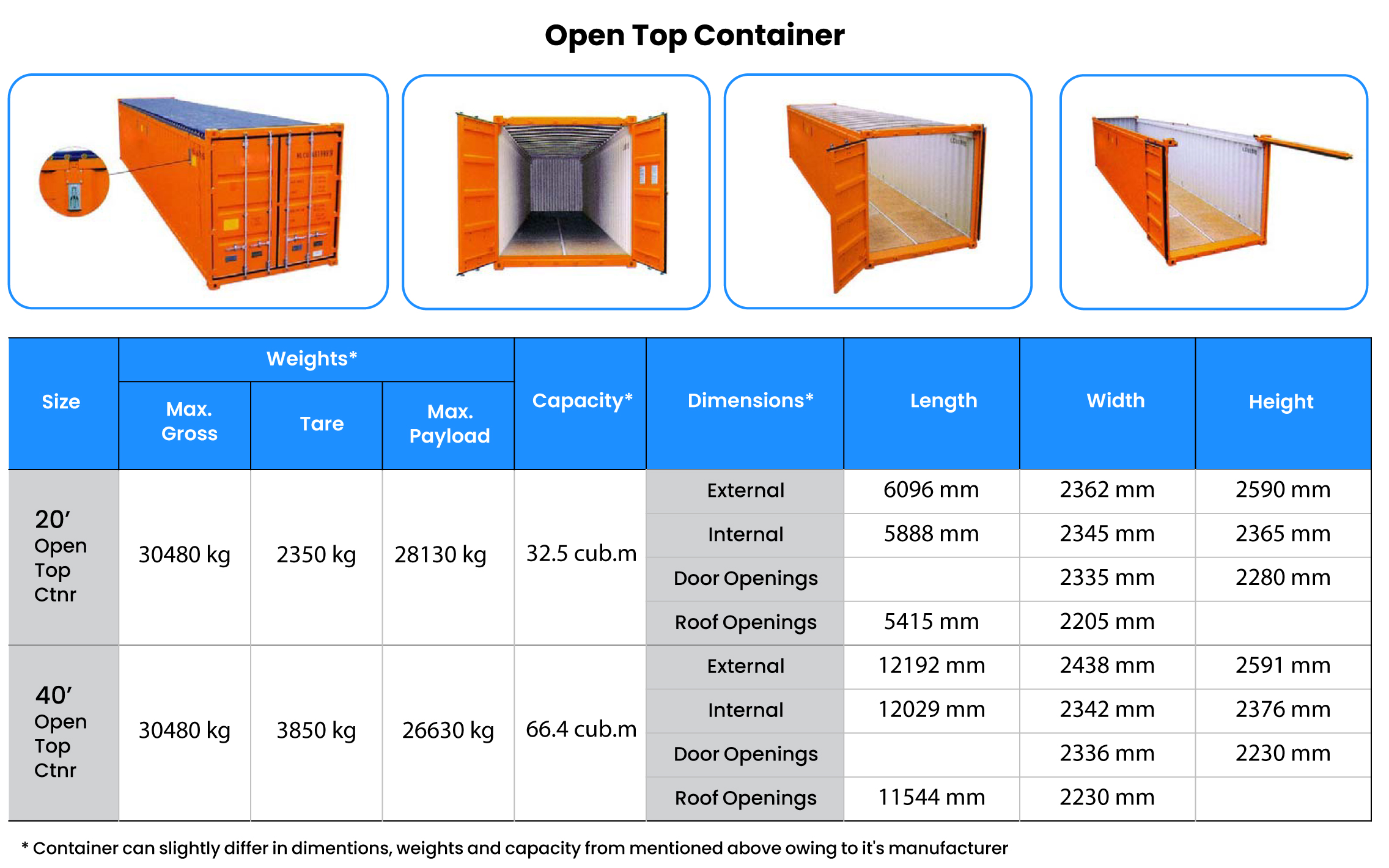
Open Top Container has the following typical distinguishing structural features: the roof consists of removable bows and
a removable tarpaulin. The door header may be swivelled out. These two
structural features greatly simplify the process of packing and unpacking the container.In particular it is very easy
to pack and unpack the container from above or through the doors by
crane or crab when the roof is open and the door header is swivelled out.
It should be noted, however, that the purpose of the roof bows of an
open-top container is not solely to support the tarpaulin but also to
contribute to container stability. Usual open-top container dimension
are 20' and 40'.
Open-type containers are used for all types of general cargo.(dry cargo).Their
principle uses are as follows:
-Packing and unpacking from above or through the doors by crane or crab
-Tall Cargo
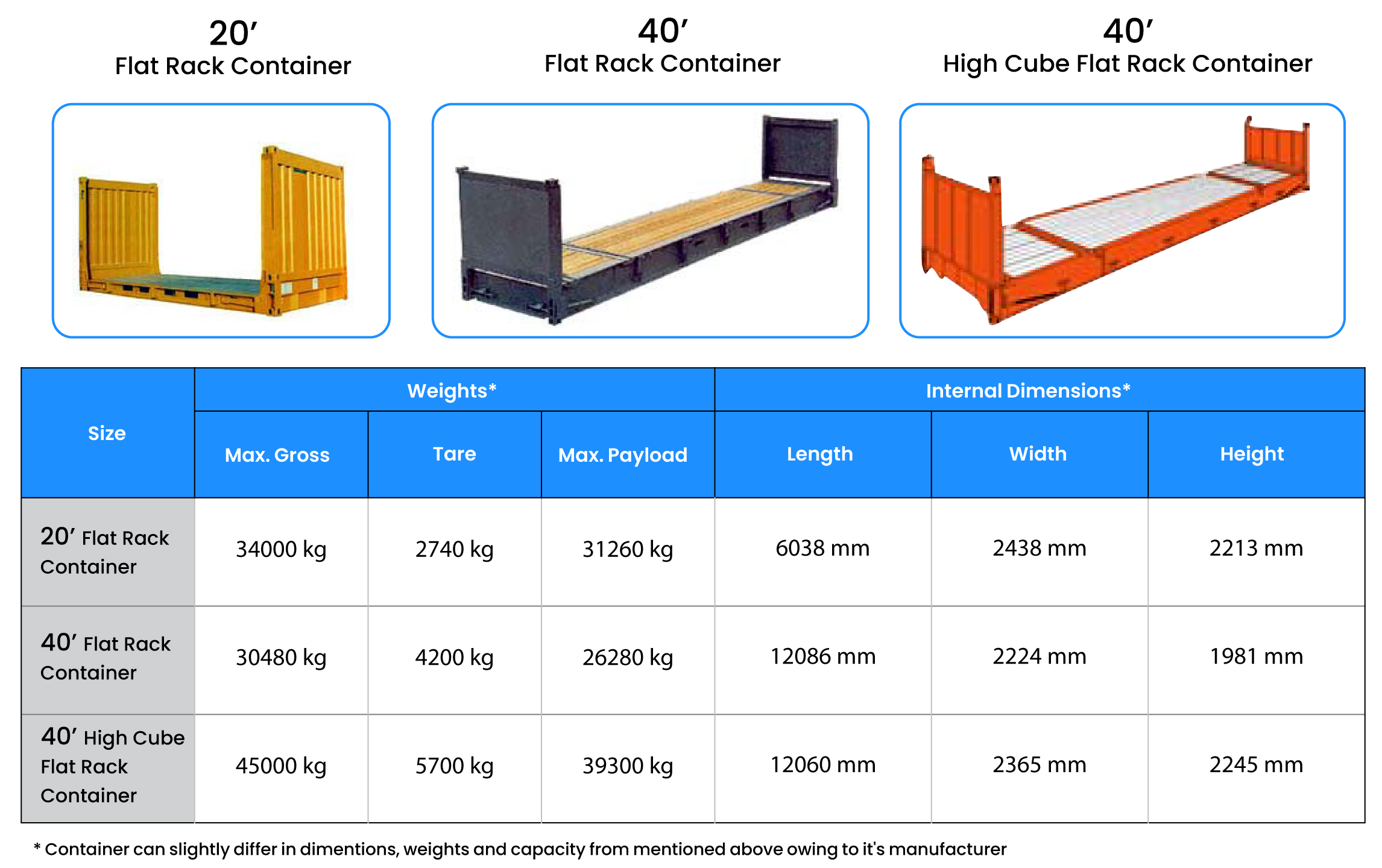
Flatracks consist of a floor structure with a high loading capacity composed of a steel frame and a softwood floor and two end walls, which may be either fixed or collapsible. The end walls are stable enough to allow cargo securing means to be attached and several flatracks to be stacked on top of one another. Flatracks are available in 20' and 40' sizes. Flatracks are mainly used to transport heavy-lifts and overheight or overwidth cargoes.
Platforms consist solely of a floor structure with extremely high loading capacity; they have no side or end walls. This high loading capacity makes it possible to concentrate heavy weights on small areas. A platform consists of a steel frame and a wooden floor structure. Platforms are available in 20' and 40' sizes. Platforms are used principally for oversized and very heavy cargoes.

Ventilated containers are also known as passive (naturally) ventilated or coffee containers. Ventilation is provided by ventilation openings in the top and bottom side rails. The openings do not let in spray, to prevent depreciation of the cargo by rain or spray, for example. The common size for ventilated containers is 20'. Ventilated containers are used especially for cargoes which have to be ventilated in transit. One of the most significant of such commodities is green coffee beans, hence the name coffee container.

Refrigerated and insulated containers are
mainly available as 20' and 40' containers. A distinction may be
drawn between two different systems:
1. Integral Units(Integral Reefer Containers, Integrated Units)
This type of refrigerated container has an integral refrigeration unit
for controlling the temperature inside the container.When being
transported by ship, integral units have to be connected to the on-board
power supply system. For transport by road and rail, most integral
unit refrigeration units are operated by a generator set(genset).
This may either be a component of the refrigeration unit or connected
to the refrigeration unit. Refrigerated containers are used for goods
which need to be transported at a constant temperature above or
below freezing point. These goods are divided into chilled goods
and frozen goods, depending on the specified transport temperature.
They principally include fruit, vegetables, meat and dairy products,
such as butter and cheese.High cube integral units are used in
particular for voluminous and light goods (eg. fruit, flowers).
Nowdays, goods requiring refrigeration are mostly transported
in integral units, which have a markedly higher market share than
porthole containers.


Bulk (or bulk cargo) containers have three loading hatches in the roof, each of a diameter of approx. 455mm (1 3/4'). The distance between the hatches (center to center) is 1.83 m (6'). On the door side, there are two discharge hatches, which are sometimes equipped with short discharge tubes for guiding the bulk cargo. Alternatively, two unloading hatches may be mounted in the doorways, for emptying the containers. Bulk containers are used in particular for transporting bulk cargo, such as grain, feedstuffs, spices.However, they may also be used for transporting general cargo.

Tank containers are used for liquid cargoes, such as: -Foodstuffs: fruit juices, spirits, sweet oils -Chemicals: hazardous materials, such as fuels, toxic substances, corrosion protection agents. If the cargo requires temperature-controlled transport, tank containers can be equipped with insulation or heating.

